|
Number
|
Description
|
|
|
 |
Students working in main excavation area
|
|
|
|
Outer wall
|
|
|
|
Wall and tower, note how the lower section,
the most ancient, is made of large blocks while the upper part is made of
thinner facing blocks and rubble filling.
|
|
|
|
Upper level of outter wall of Chernonese.
Note how the removal of the facing of drested stone reveals that the interior
of the wall - rubble - has considerable strength.
|
|
|
|
Overview of area toward Sevastopol. The Greek
city was on a headland that is now part of the southwestern section of enlarged
Sevastopol. During the Crimean War this area was still outside the city and was
occupied by French troops whose besieging lines were on top of the ancient
ruins. The city wall shown in the previous photos is directly behind the
foliage.
|
|
|
|
View down onto the outer wall and tower - The
previous photos of are the wall at left - and below are photos of the group
walking between these walls - entrance way is behind and adjacent to the cross
wall in foreground.
|
|
|
|
Archeological work crew in main site
|
|
|
|
Work team with basilica behind
|
|
|
|
View of outer wall
|
|
|
|
Archeological project by wall
|
|
|
|
Dr Antonova leading Misha and Dr Turovskii, entering site at
Chersonese
|
|
|
|
Misha, George and Drs Antonova and Turovskii by outer city wall
|
|
|
|
Inscription on stone later used to build wall
|
|
|
|
An interior wall with basilica in background
|
|
|
|
Modern building
|
|
|
|
Mosaic floor, part of the 'Basilica within a Basilica" described
on pages 103-106 of Crimean Chersonesos. See the book for discussion of
the iconography of the designs.
|
|
|
|
Mosaic floor in another part of the same basilica
|
|
|
|
Mosaic floor, also in a section of this basilica. Dr Carter's book
mentions that these have been removed now for preservation.
|
|
|
|
Misha by Greek columns of this same structure. It is described in
Crimean Chersonesos as originally a 6th century basilica destroyed in the 10th
century and then the smaller basilica was rebuilt inside the earlier area.
|
|
|
|
City wall - view to Constantine bastion across harbor mouth
|
|
| |
|
Telephoto picture of the Constantine fortress that existed there during
the Crimean War.
|
|
|
|
George and Misha discussing ruin with Dr Turovskii.
|
|
|
|
Shrine built over spot said to be where Vladimir was baptised.
|
|
|
|
View across ruin into Sevastopol.
|
|
|
|
Archeological work in main area.
|
|
|
|
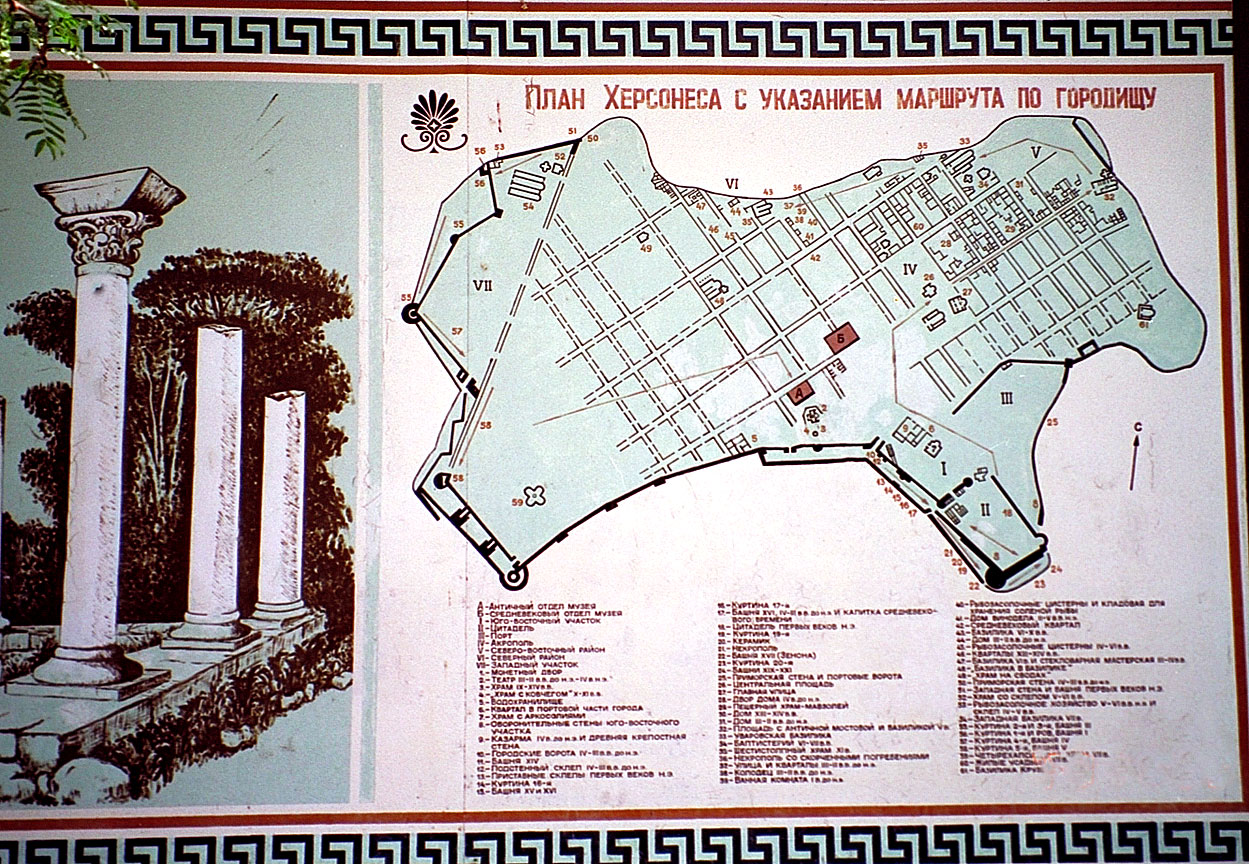
Map plan of city in museum.
|
|
|
|
19th century basilica of the Church of St
Vladimir
|
|
| |
|
19th century basilica next to Greek ruins.
|
|
|
|
Beach, city wall along shore, Fort Constantine in distance.
|
|
|
|
Greek columns, house foundations.
|
|
|
|
The "Basilica within a Basilica".
|
|
|
|
Headland by city and view across harbor entrance.
|
|
|
|
View from Chersonese toward the entrance to Sevastopol harbor with the
white Fort Constantine in the opposite headland. This section is a popular
bathing beach for the local population.
|
|
| |
|
Another mosaic floor
|
|
| |
|
View of city wall from inside the ruins
|
|
| |
|
Discussing another section of the wall with Dr. Antonova
|
|
| |
|
Micha and John discussing the wall with Dr. Antonova
|
|
| |
|
The Judgment of Paris
|
|
| |
|
The memorial to Vladimir's conversion
|
|
| |
|
19th century basilica of the Church of St Vladimir
|
|
| |
|
View from northern edge of Chersonese across the entrance to Sevastople
harbor
|
|
| |
|
19th century basilica of the Church of St Vladimir
|
|
| |
|
View of the Black Sea across the excavated ruins on shore - the mound
to left has ruins yet to be excavated and the area by the coast is off limits
with modern fortifications.
|
|
| |
|
View of the Black Sea across the ecavated ruins on shore - the mound to
left has ruins yet to be excavated and the area by the coast is off limits with
modern fortifications.
|
|
| |
|
View of the Black Sea across the ecavated ruins on shore - the mound to
left has ruins yet to be excavated and the area by the coast is off limits with
modern fortifications.
|
|
| |
|
Dr Carter titles this structure as the "1935 Basilica" after
the date of its excavation. It was Christian basilica from the 6th to end of
10th centuries. See pages 107 - 109 of Crimean Chersonesos.
|
|
| |
|
Another photo of a mosaic floor
|
|
| |
|
Our tour group in 1992 discussing the city wall
|
|
| |
|
View into the 'moat' between the city wall and retaining wall
|
|
| |
|
Foundations of homes
|
|
| |
|
Dr Antonova leading Misha and Dr Turovskii, entering site at Chersonese
|
|
| |
|
|
|
| |
|
|
|